
The Illusion of Control: Why Your Digital Parenting Strategy is Failing
It seems like you’re under a lot of pressure.
You’re staring at a screen, scrolling through "Best Parental Control Apps of 2026," and every single one of them promises the world. They promise safety. They promise "peace of mind." But let's be honest—when you look at those apps, all you feel is anxiety.
You’re terrified that if you don't monitor every text, something catastrophic will happen. But you’re equally terrified that if you do monitor them, you’ll become the enemy in your own home. You feel like you’re being forced to choose between being a "spy" or being "negligent."
That’s a false choice. And it’s a dangerous one.
The Negotiator’s Reality
In a high-stakes negotiation, the worst thing you can have is a "blind spot." Right now, your blind spot is the hidden cost of these apps. Most parents buy based on a "feature list." They see "Keylogger" or "Snapchat Monitoring" and think, Perfect, I’m protected.
But they haven't accounted for the Sanity Tax.
If an app gives you a 10/10 protection level but requires you to jailbreak your kid’s phone and spend four hours a week sifting through raw data, you haven't bought safety. You’ve bought a second job that ruins your relationship with your child.
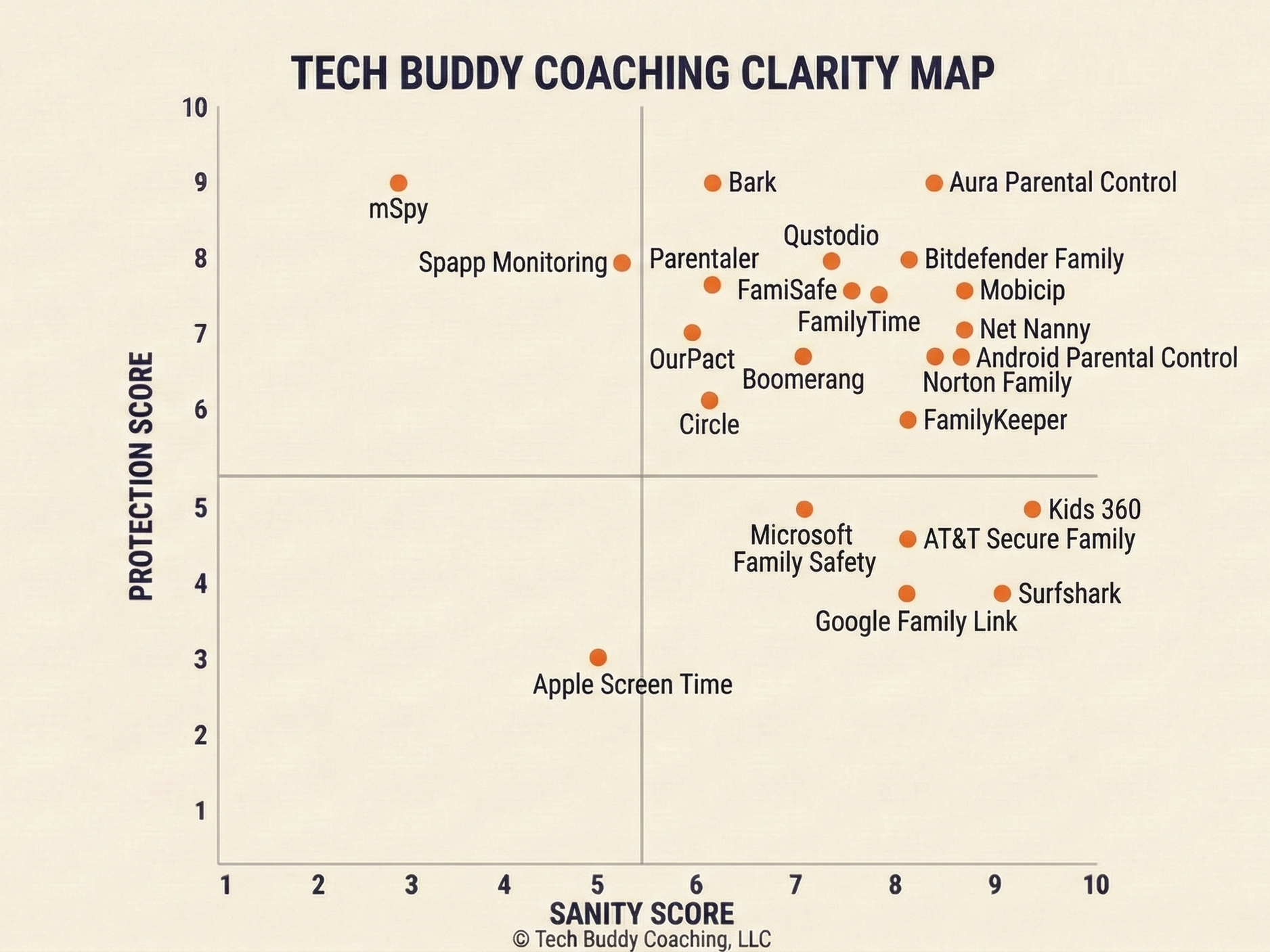
The Tech Buddy Coaching Clarity Map
We didn't design this map to sell you an app. We designed it to reveal the truth of the landscape.
The Clarity Map plots the world's most popular tools on two cold, hard axes: Protection (The "What") and Sanity (The "How").
The "Spy" Trap: Look at the top left. Apps like mSpy have elite Protection scores. But their Sanity scores are basement-level. They function like invasive surveillance. If you go this route, you’re not negotiating for safety; you’re declaring war on your child’s trust.
The "Feel-Good" Mirage: Look at the bottom right. Apple Screen Time and Google Family Link. High Sanity, but the Protection is anemic. They make you feel like you’re doing something, but a tech-savvy twelve-year-old can bypass them in minutes. It’s an illusion of security.
The Strategic Sweet Spot: The upper-right quadrant. This is where Aura, Bark, and Qustodio live. These tools recognize that a parent’s time is a finite resource. They use AI to flag the risks so you don't have to read every message.
How Do You Want This to End?
You have a choice to make, and the stakes couldn't be higher. You can keep guessing, downloading apps, and hoping for the best while the friction in your house keeps rising. Or, you can look at the data and make a calibrated decision.
How much is your relationship with your child worth? And how much is your own time worth?
If you’re ready to stop reacting and start leading your family’s digital life, we have a way forward.
Your Next Move
Don't just pick an app because it's "top-rated." Tell us what your "OH NO" is—the one thing that keeps you up at night—and we’ll show you exactly where it sits on the Clarity Map. We’ll filter the noise and give you the two specific tools that fit your family's ecosystem without breaking your sanity.
Use this link and reach out to us